many organisations have wide-ranging and complex disclosure needs, but are often reliant on outdated disclosure processes that are not only labour intensive and costly, but also compromise on-going and affective decision-making.
IT and business owners are often involved in identifying, collecting, and copying relevant information across an ever-expanding range of business applications, media storage devices and digital collaboration tools. But as the collected information tends to be siloed in separate formats, it cannot be holistically reviewed, resulting in manually driven disclosure practices that are time consuming, unreliable, and costly.


Informa’s cloud-based platform benefits from machine learning technology. As well as providing superior search capabilities, the collected information is accessible for decision-making within a single repository, regardless of format. Automating important disclosure steps from information collection to the initial review stage, ensures that otherwise tedious repetitive manual processes such as deduplication, redaction methodology and, the recording and scheduling of decision-making, are reliably achieved at speed.
Stet clita bergren, no sea takimata sanctus est Lorem ipsum dolor sit amet. Lorem ipsum dolor sit amet, consetetur sadipscing elitr sed diam nonumy eirmod tempor invidunt ut labore et dolore magna aliquyam erat. Dicta sunt explicabo. Nemo enim ipsam voluptatem quia voluptas sit aspernatur aut odit aut fugit, quia.
Informa’s secure courier collect the Bound Volumes in 1 bulk collection. Each volume will receives its own barcode and this is entered onto our DIMMS system as an asset. This barcode detail will be added onto our collection order/manifest for signature by our driver with your authorised personnel
For each project that Informa takes on a job is created on Dimms (Information Management & Monitoring System) to create a unique job number which follows that batch through our bureau cycle from intake to return.
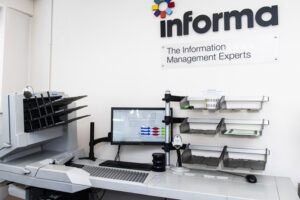
When the Minute Books arrive with Informa, it will be registered at reception and tracked on our DIMMS Asset Management Module and transported directly to this scanning room. The containers are stored on shelving in our warehouse or secured in cages in the project room.
All electronic data received and generated is routed to an isolated area on our server where only data relating to each individual batch resides. This folder structure is automatically created via DIMMS once a job is registered.
Informa’s capture technician is to ensure all items have been captured, this process ensures all bound volumes are checked for physical integrity and client notes made and reported on. The bound volumes are made ready for production.
Through our bureau software all scanners will record the number of documents and pages against each bound volume and the operators will then validate the counts on our DIMMS system (manual counts V automated counts). Manual job sheets are filled out by all operators with the manual counts. Operators also log any issues/errors on these job sheets which are available to all clients if requested.
Informa’s Quality Check Supervisor uses advanced LIMB management software to overview the capture work. This is always treated as a second step and a second set of eyes. At this stage images are post capture edited to ensure splitting, image quality cropping and skewing are as per clients requirements and specifications. Any documents failing these specifications are logged and are sent for recapture at that stage. Physical files may be used for comparison at this stage if required.
Metadata is attributed to each image and complied file. Metadata specifications can be embedded and provided as load file if required. Metadata format can be multiple formats including Dublin Core etc.
At this stage the Archive has the option for Informa to use their machine learning technology to transcribe any handwritten text within the Minute Books making them more accessible and searchable. This would enrich Minute Books with metadata. The technology is equipped with recognising all handwriting styles quickly with high levels of accuracy. Please see image below as an example.
The digital file integrity is checked, and files are published in the required multiple formats specified. These are programmed for consistency. Sampling of output is performed.
The Minute Books are to be imaged at preservation resolution (400 DPI) for long term storage. Each file is to be captured and saved as an uncompressed 24-bit TIFF file.
Surrogate set of images to be supplied as PDF/A-2b with no watermark and PDF with watermark ‘Archives’.


 Call Us Now