For centuries, archives have been the silent guardians of human history. Shelves upon shelves of ledgers, letters, and diaries hold the secrets of the past. But for just as long, much of that history has been locked away—trapped behind the beautiful but often illegible barrier of handwriting.
Archivists know this struggle intimately. You have a collection of 18th-century local council records that could redefine local history, but transcribing them manually would take decades. This is the bottleneck of modern archiving: Informa can digitise images instantly, but digitising the text inside them is a different beast entirely.
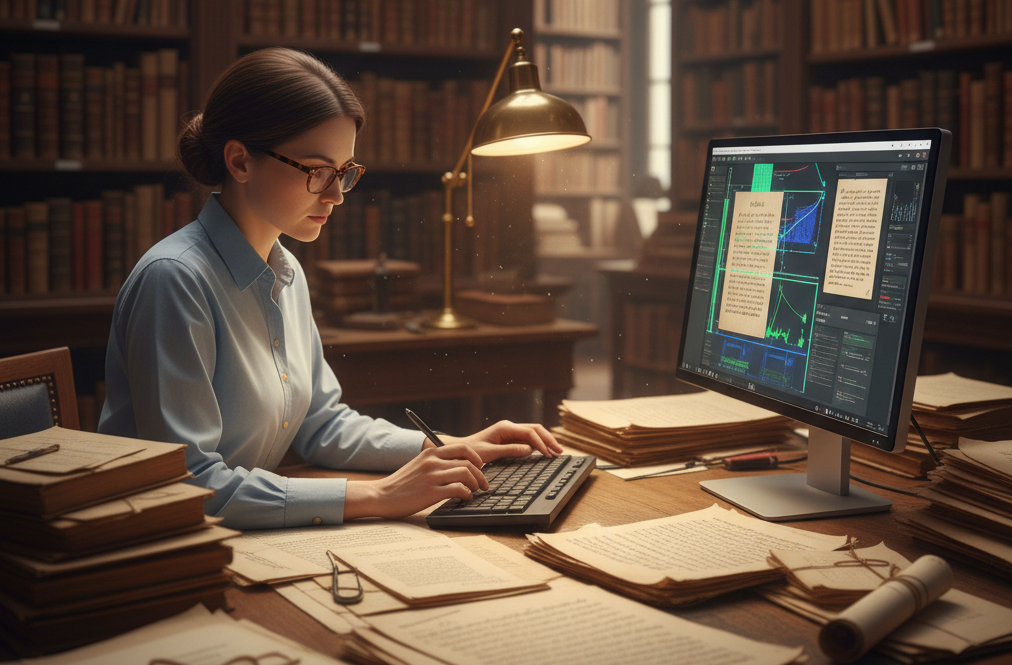
This is where Hand-Written Text Recognition (HTR) technology steps in. specifically the powerful platform Transkribus. With the release of its new model, “Text Titan I ter”, the game is changing once again. We are moving from simply scanning pages to truly understanding them at scale.
Before diving into the solution, we must acknowledge the problem. Handwritten documents are notoriously difficult for computers to process. Unlike printed text, which follows rigid rules of font and spacing, handwriting is chaotic.
Every scribe has a unique hand. A loop in a “g” from a 16th-century monk looks nothing like the “g” in a Civil War soldier’s letter. Add to this the physical degradation of the documents—faded ink, water stains, torn edges, and bleed-through from the other side of the page. Traditional Optical Character Recognition (OCR) tools, designed for crisp printed text, fail miserably here. They churn out gibberish, turning valuable historical data into digital noise.
Until recently, the only reliable alternative was manual transcription. This requires skilled experts who can decipher palaeography. It is slow, expensive, and physically taxing. Even a dedicated team can only process a fraction of a large collection in a year. This leaves the vast majority of archival material “dark”—scanned, perhaps, but unsearchable and undiscoverable.
Transkribus has emerged as the leading platform for tackling these challenges. It isn’t just an OCR tool; it is a comprehensive ecosystem designed for historical documents. It uses machine learning to train on specific handwriting styles.
If you are working with a collection of letters from a specific author, you can “teach” Transkribus to read that author’s handwriting. You feed it a few pages of manual transcription (the “Ground Truth”), and the AI learns the shapes and patterns of the characters.
This capability alone was revolutionary. It allowed archives to create custom models for specific collections. However, creating custom models takes time and effort. Archivists needed something more robust—a model that could work right out of the box on a wide variety of documents without extensive training.
This brings us to the latest leap forward: the Text Titan I ter model.
Text Titan I ter represents a significant evolution in HTR technology. It is a “super model” designed to handle the complexity and variety of handwritten text with unprecedented accuracy.
The magic of Text Titan I ter lies in its training data. It has been fed a massive, diverse diet of historical scripts spanning different centuries, languages, and styles. This means it generalises better than previous models. You can throw a document at it that it has never seen before—written in a style it wasn’t specifically trained on—and it has a much higher chance of producing a usable transcript immediately.
Historical documents are rarely neat. They have marginalia, crossed-out lines, and text written in different directions. Text Titan I ter is better equipped to distinguish the main body of text from these extraneous elements, reducing the amount of cleanup archivists need to do post-processing.
For collections that are truly unique, you might still want to fine-tune a model. Because Text Titan I ter provides such a strong foundation, you need significantly less “Ground Truth” data to train it for your specific needs. Instead of transcribing 50 pages to start, you might get excellent results with just 10 or 15.
What does this mean for the day-to-day work of an archivist? The shift is practical and immediate.
Imagine a user searching for a specific ancestor in a collection of 10,000 handwritten wills. Previously, they would have to read through images one by one. With Transkribus and Text Titan I ter, the archive can extract the text from all 10,000 documents. That collection becomes a searchable database. A search for “John Smith” instantly pulls up every mention, complete with a link to the original image.
Historians and researchers can analyse trends across millions of words. They can use the extracted text for linguistic analysis, sentiment analysis, or topic modelling. This allows for “distant reading,” where scholars can spot patterns in history that would be impossible to see by reading documents individually.
Searchable text is accessible text. For visually impaired users who rely on screen readers, image-only archives are useless. By extracting the text, we make history accessible to everyone, ensuring compliance with modern accessibility standards and opening the doors of the archive to a wider audience.
Consider a hypothetical project digitising parish records from the 1800s. These records are vital for genealogy but are notoriously messy. The handwriting varies from priest to priest.
Using older models, the archive team might achieve a Character Error Rate (CER) of 15-20%. This means one in every five or six characters is wrong, making the text difficult to search.
By switching to Text Titan I ter, that same team could see the CER drop to 5% or less right out of the box. Suddenly, names, dates, and locations are being recognised correctly. The time spent correcting the AI’s mistakes drops by half. The project finishes months ahead of schedule, and the public gets access to their heritage faster.
The goal of archiving has always been preservation and access. For a long time, preservation took precedence because access was so difficult to provide. Tools like Transkribus and the Text Titan I ter model are rebalancing that equation.
We are no longer just preserving the physical object or its digital image. We are preserving the information itself in a format that is alive, searchable, and usable.
For archivists, this technology is not about replacing human expertise. It is about amplifying it. It removes the drudgery of basic transcription, freeing up professionals to do what they do best: provide context, interpret meaning, and curate collections.
If you have a backlog of handwritten material waiting to see the light of day, it is time to look at what Text Titan I ter can do. The key to unlocking your archive might be just a click away.





 Call Us Now